Radar, Not Eyeballs: The End of Visual Separation
Sometimes FAA rule changes make major headlines, like the recent rescinding of single-pilot exemptions for legacy Cessna Citation business jets.
But other times, like in the case of an FAA general notice (GENOT) that took effect in March, a major rule change might fly under the radar. That doesn’t mean these notices aren’t worthy of our attention.
In the case of the March 18, 2026 GENOT, the FAA suspended clearance for visual separation between helicopters and airplanes in Class B, Class C, and Terminal Radar Service Areas (TSRAs). Tower personnel are now required to rely on radar to ensure proper separation.
You’ll remember that about a year prior to the rule change, there was a deadly collision near Ronald Reagan Washington National Airport (DCA) between an Army UH-60 and a PSA CRJ 700. After many months reviewing mixed helicopter and airplane operations nationwide, the FAA concluded that the system leaned too heavily on see-and-avoid in high-traffic airspace.
Two near-misses early this year further made the case that change was needed. In February, a police helicopter crossed the final approach path of an American Airlines jet landing at San Antonio (SAT). Then in March, a helicopter conflicted with a Beech 99 on final approach at Hollywood Burbank (BUR). Fortunately, in both cases, the helicopter pilot turned away in time, but it was closer than anyone should accept.
The FAA directive impacts not only the major transportation hubs, but hundreds of smaller airports across the United States. For example, at South Bend International Airport (SBN), Enstrom’s sister company Sweet Helicopters provides aerial support for the Notre Dame Police Department during home football games and stadium concerts.
The stadium itself falls under the final approach path of RWY 27L. For many years, our flight patterns consisted of navigating around the perimeter of the university at 300-500 feet above ground. Whenever a plane began to make its approach, the tower operator would call me, saying something like, “Copter 1, you have traffic at your 3 o’clock position, five miles out, on the final for 27L. Let me know when you have them in sight.”
I’d then respond with “I have the traffic in sight. I will maintain the visual separation.”
At that point, the tower controller would issue us clearance to maintain visual separation, allowing us to keep making our circuits above the university and work with law enforcement to watch for bad guys and traffic snarls.
But, according to the supervisor I spoke to at SBN ATC recently, that’s no longer possible. He said helicopter pilots can expect to have to hold at least one mile, north or south, of the extended centerline and maintain at least 500 feet vertical separation with the opposing aircraft or target resolution. In other words, with the influx of inbound traffic on game days, Sweet Helicopters will be spending a lot more time away from campus waiting for aircraft to land this season.
Practical Habits
So, what does this mean to you as an Enstrom pilot?
- Plan for delay. Build extra time and fuel into any flight that touches Class B, Class C, or a TRSA. Expect fewer “approved as requested” transits. Holding outside the airspace while ATC sorts out traffic is now a normal part of the day, not an exception.
- Have a plan B. Know your route around the airspace before you call up, so “remain clear” doesn’t force decisions on the fly.
- Fly the altitude you’re given. Under radar separation, vertical distance is often the tool keeping you apart from the jet above. A few hundred feet of drift is exactly what the system is counting on you not to do.
- Be crisp on the radio. Give position, altitude, and intentions clearly and early. Controllers are working harder to fit us in; make it easy for them.
- Keep looking anyway. The GENOT shifts separation responsibility to ATC. It does not repeal 14 CFR 91.113 or your duty to see and avoid. The San Antonio and Burbank pilots are proof that your eyes remain a crucial last line of defense.
It’s easy to read this as the FAA making life harder for helicopter pilots. A better read is that the system is taking on a job it arguably should have been doing all along. As pilots, our part is patience, precision, and a sharp lookout.
Fly safe!
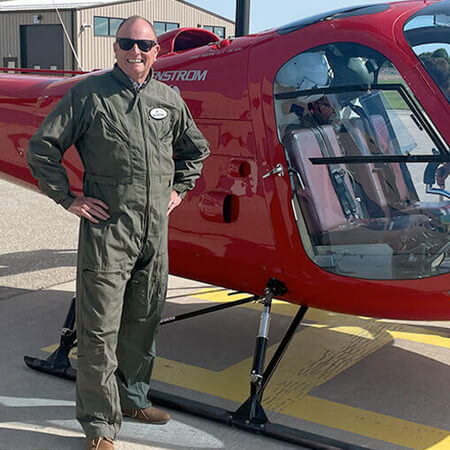
Randy is a dual rated Airline Transport Pilot with 13,000 flight hours in airplanes and helicopters. He has type ratings in the BE400 and CE500 and is a retired Designated Pilot Examiner. Currently he works for Sweet Helicopters, a northern Indiana Part 135 air carrier operator and serves as the Airport Manager of the Goshen Municipal Airport.
About Enstrom Helicopter
From Rudy Enstrom’s early designs in 1943 to initial testing in a Michigan Quarry in 1957 to aircraft operating on six continents, Enstrom Helicopter Corporation has maintained a reputation for safety, value and performance. Based in Menominee, Michigan and proudly made in the United States, Enstrom has a rich history for design innovation. The goal is to provide helicopters to the customer’s exact specification and deliver support and maintenance worldwide.