Safety Check – Radio Blah Blah
My first real aviation job was with the Miles Lab (now Bayer) corporate flight department. I probably had fewer than 500 hours of total flying time, and it was my big break – a chance to fly an aircraft that didn’t require walking on the wing to enter the cockpit.
The chief pilot assigned me to the O’Hare shuttle on board the company’s Beechcraft King Air 200. He asked me if I would be comfortable operating radios at the world’s busiest airport. Before I could even answer, he said, “You’ll be fine. Just keep it short, concise, and professional.”
Forty-two years later, and that advice still holds true.
Chris Houser, a flight instructor and Bell 429 corporate pilot, teaches his students to announce who they are, where they are, and what they’re doing in the fewest words possible. During a recent flight review, Chris remembered an experienced helicopter pilot’s flying skills being overshadowed by sloppy radio communication. The pilot’s attempts to talk “cool” resulted in overly verbose and uninformative radio chatter. In the post-flight briefing, Chris recommended the chatty pilot review Chapter 4, Section 2 of the Aeronautical Information Manual (AIM), which covers the rules, phraseology, and techniques for effective radio communication.
As the Airport Manager at Goshen Municipal (GSH), my office is within earshot of the CTAF radio, so I regularly hear most of what’s broadcast. All too often, I hear pilots use fad phrases and slang that pollutes communication and leaves room for misunderstanding. I spoke to a TRACON controller who shared with me a few pet peeve examples of what we refer to as “noncompliant radio phrases.”
- “I’ve got the traffic on the fish finder.” This cutesy expression refers to traffic displayed on an electronic device. Just say, “negative contact” and leave fish finders to boats.
- “Departing the traffic pattern to the west. Last call.” By announcing you are departing the traffic pattern, the “last call” is implied, so explicitly stating “last call” is redundant.
- “See yuh!” This phrase gets old fast. Acknowledge the hand-off frequency and let it go at that.
- Mic clicking. Some pilots will simply double tap the push-to-talk button as a form of acknowledgement in situations when verbal confirmation is necessary.
- “Big jet 123 is ten miles out. Straight-in to the active runway. All other traffic in the area please advise.” This is nothing but an invitation to clog up an already congested frequency as pilots walk over each other to respond to the inbound jet. For the best situational awareness, just keep your ear to the CTAF within range.
Danny Yates, a friend of mine who works for an airline, summarized it best, “Radio phraseology is in the AIM. Don’t add to it.” His airline flew routes to South America where English is rarely a first language, making non-standard jargon just another barrier to understanding.
You might remember a news report from April about airline pilots making meowing and barking sounds over the guard frequency (used for emergencies) near the Ronald Reagan Washington National Airport (DCA). This type of juvenile behavior would normally go without fanfare, but it achieved viral infamy for its connection to a deadly crash the year prior. Their antics took place in the same airspace where a regional jet collided mid-air with an Army helicopter, resulting in the deaths of 67 people. I’m sure the meowing and barking pilots from April meant no harm, but they should have realized that their actions could have consequences. The FAA is investigating the incident.
Flight instructors, teach your students that words have precise meanings. Precision isn’t just for emergencies. Start practicing proper radio communication today.
I’m reminded of British rock band Queen and their 1984 hit tribute to the radio, “Radio Ga Ga.” Freddie Mercury sings, “You made us feel like we could fly, so don’t become some background noise.” As helicopter pilots, we already have enough background noise. Enough of the radio blah blah!
Last call.
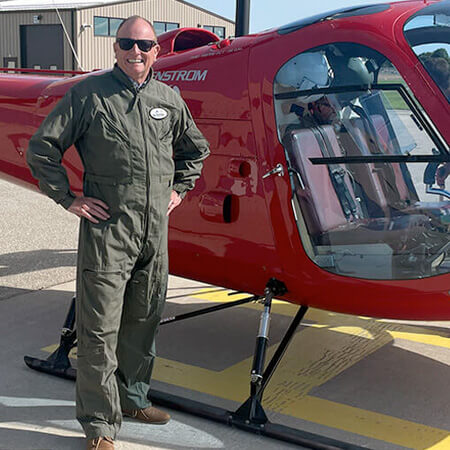
Randy is a dual rated Airline Transport Pilot with 13,000 flight hours in airplanes and helicopters. He has type ratings in the BE400 and CE500 and is a retired Designated Pilot Examiner. Currently he works for Sweet Helicopters, a northern Indiana Part 135 air carrier operator and serves as the Airport Manager of the Goshen Municipal Airport.
About Enstrom Helicopter
From Rudy Enstrom’s early designs in 1943 to initial testing in a Michigan Quarry in 1957 to aircraft operating on six continents, Enstrom Helicopter Corporation has maintained a reputation for safety, value and performance. Based in Menominee, Michigan and proudly made in the United States, Enstrom has a rich history for design innovation. The goal is to provide helicopters to the customer’s exact specification and deliver support and maintenance worldwide.